A very common problem in computer programming is finding the longest increasing (decreasing) subsequence in a sequence of numbers (usually integers). Actually this is a typical dynamic programming problem.
Dynamic programming can be described as a huge area of computer science problems that can be categorized by the way they can be solved. Unlike divide and conquer, where we were able to merge the fairly equal sub-solutions in order to receive one single solution of the problem, in dynamic programming we usually try to find an optimal sub-solution and then grow it.
Once we have an optimal sub-solution on each step we try to upgrade it in order to cover the whole problem. Thus a typical member of the dynamic programming class is finding the longest subsequence.
As we already know the algorithm of Kruskal works in a pretty natural and logical way. Since we’re trying to build a MST, which is naturally build by the minimal edges of the graph (G), we sort them in a non-descending order and we start building the tree.
During the whole process of building the final minimum spanning tree Kruskal’s algorithm keeps a forest of trees. The number of trees in that forest decreases on each step and finally we get the minimum weight spanning tree.
A key point in the Kruskal’s approach is the way we get the “next” edge from G that should be added to one of the trees of the forest (or to connect two trees from the forest). The only thing we should be aware of is to choose an edge that’s connecting two vertices – u and v and these two shouldn’t be in the same tree. That’s all.
An important feature of the Kruskal’s algorithm is that it builds the MST just by sorting the edges by their weight and doesn’t care about a particular starting vertex.
We saw how to find the shortest path in a graph with positive edges using the Dijkstra’s algorithm. We also know how to find the shortest paths from a given source node to all other nodes even when there are negative edges using the Bellman-Ford algorithm. Now we’ll see that there’s a faster algorithm running in linear time that can find the shortest paths from a given source node to all other reachable vertices in a directed acyclic graph, also known as a DAG.
Because the DAG is acyclic we don’t have to worry about negative cycles. As we already know it’s pointless to speak about shortest path in the presence of negative cycles because we can “loop” over these cycles and practically our path will become shorter and shorter.
The presence of a negative cycles make our atempt to find the shortest path pointless!
As we saw in the previous post, the algorithm of Dijkstra is very useful when it comes to find all the shortest paths in a weighted graph. However it has one major problem! Obviously it doesn’t work correctly when dealing with negative lengths of the edges.
We know that the algorithm works perfectly when it comes to positive edges, and that is absolutely normal because we try to optimize the inequality of the triangle.
Since all the edges are positive we get the closest one!
Since Dijkstra’s algorithm make use of a priority queue normally we get first the shortest adjacent edge to the starting point. In our very basic example we’ll get first the edge with the length of 3 -> (S, A).
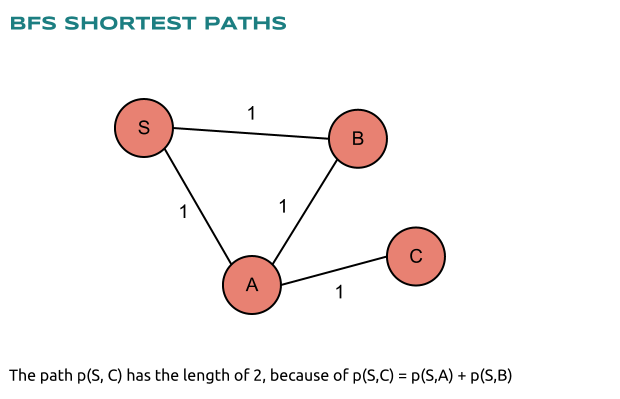
We already know how we can find the shortest paths in a graph starting from a given vertex. Practically we modified breadth-first search in order to calculate the distances from s to all other nodes reachable from s. We know that this works because BFS walks through the graph level by level.
BFS is often used to find shortest paths between a starting node (s) and all other reachable nodes in a graph!
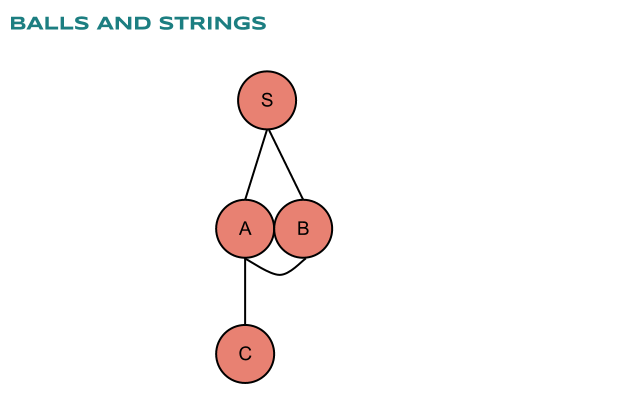
Some sources give a very simple explanation of how BFS finds the shortest paths in a graph. We must just think of the graph as a set of balls connected through strings.
We can think of a graph as a set of balls connected through strings!
As we can see by lifting the ball called “S” all other balls fall down. The closest balls are directly connected to “s” and this is the first level, while the outermost balls are those with longest paths.
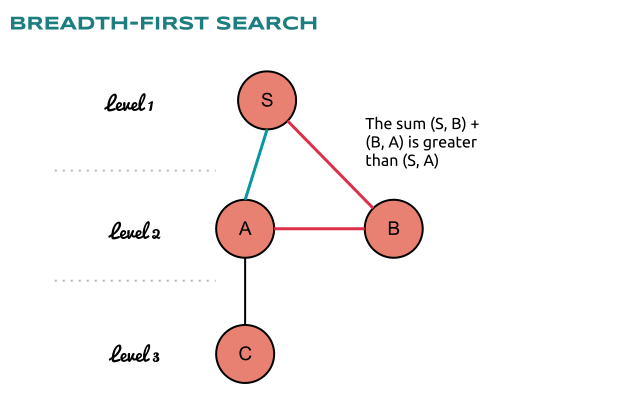
Breadth-first search works much like the image above – it explores the graph level by level, thus we’re sure that all the paths are the shortest!
Clearly edges like those between A and B doesn’t matter for our BFS algorithm because they don’t make the path from S to C through B shorter. This is also known as the triangle inequality, where the sum of the lengths of two of the sides of the triangle is always greater than the length of the third side.
What the triangle inequality says us is that if we have a direct edge between two nodes – that must be the shortest path between them!
We must only answer the question is BFS the best algorithm that finds the shortest path between any two nodes of the graph? This is a reasonable question because as we know by using BFS we don’t find only the shortest path between given vertices i and j, but we also get the shortest paths between i and all other vertices of G. This is an information that we actually don’t need, but can we find the shortest path between i and j without that info? Continue reading Computer Algorithms: Dijkstra Shortest Path in a Graph→