Category Archives: web development

Send Authenticated POST Request with Zend_Http_Client


There is an easy way to send requests with Zend_Http_Client either in GET and POST. Actually you can request not only with GET and POST methods, but with any other http request method.

$httpClient = new Zend_Http_Client('http://....');
// request via post
$response = $httpClient->request(Zend_Http_Client::POST);
// or get
$response = $httpClient->request(Zend_Http_Client::GET);

However the interesting and useful thing is that you can perform authenticated requests:

$httpClient = new Zend_Http_Client('http://username:password@example.com');
// or define it later
$httpClient = new Zend_Http_Client('http://example.com');
$httpClient->setAuth('username', 'password');

That’s an opportunity to send/receive authenticated POST requests.

$httpClient = new Zend_Http_Client('http://username:password@example.com');
// now post
$httpClient->request(Zend_Http_Client::POST);

Friday Algorithms: Sorting a Set of Integers – Far Quicker than Quicksort!

Yes! It’s really really fast, and it’s far quicker than the quicksort algorithm, which is considered as the fastest sorting algorithm in practice. However how it’s possible to be faster than the quicksort, which is the fastest algorithm?! Is that true? Actually it’s true, but only in few cases. It works with integers, you’ve to know the first and the last element from that set and you’ve to be sure that every element is unique

Imagine you’ve a set of numbers all of them greater than 1 and lesser than 1000. Of course you’re not suppose to have all of the integers between 1 and 1000, but only few of them – think of 500 numbers between 1 and 1000! Here’s important to note – that this is only an example, you can have far more than only few numbers between 1 and 1000 – what about the numbers between 1 and 1,000,000 – this is a big set, isn’t it.

The question is – if there are so many constraints, why should I use that algorithm instead of quicksort, or another sorting algorithm, that works with everything. The answer is clear – yes, you’d prefer quicksort if you’ve to sort some arbitrary data, but when it comes to integers, and you’ve, let’s say, 1,000,000 integers, my advice is – use this algorithm!

Sorting the Set

1. First Pass

First we have an unsorted array, but we know the minimum and maximum of the set.
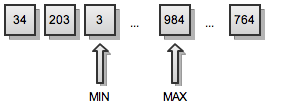
an unsorted array of integers

On the first pass initialize an empty array with as many elements, as they are between the first and the last element of the set – for a set between 1 and 1000 – that will be an array with 1000 elements – each of which will be a zero in the beginning.
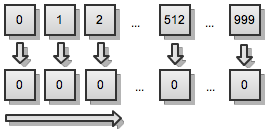
temporary array with 0 on every element

Than loop trough the set and for every element in the set – you should put a 1 on it’s place

sort a set - first pass

Now we have an array of 0 and 1.

2. Second Pass

After the first pass, you’d guess what you’ve to do – loop trough the second array and print the keys of the elements different from 0 – those that are 1.
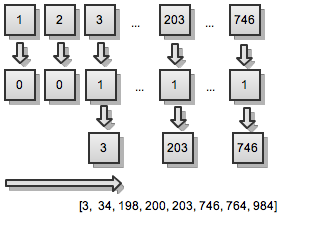
a sorted set of integers

Now the array is sorted!

Source Code

var a = [34, 203, 3, 746, 200, 984, 198, 764];
 
function setSort(arr)
{
    var t = [], len = arr.length;
    for (var i = 0; i < 1000; i++) {
        t[i] = 0;
    }
 
    for (i = 0; i < len; i++) {
        t[arr[i]] = 1;
    }
 
    for (i = 0; i < 1000; i++) {
        if (1 == t[i]) {
            console.log(i);
        }
    }
}
 
setSort(a);

Now that you’ve seen that algorithm, perhaps you’d guess that it’s no so difficult to change from integers to any other set, and once again I should say that in many cases this is the best algorithm for sorting! Very often quicksort is preferred, but not always there isn’t something faster!

Joomla! – Old Code or Bad Code?

Recently I started managing a small system based on Joomla 1.0.15. I know there is a most recent version of the popular CMS, but this one wasn’t based on it. Actually once upon a time I was working with Joomla as basic CMS for my web projects, but now after two+ years with Zend Framework and MVC I was amazed to see how bad the Joomla 1.0.15 was written.

Indeed it is really strange to see all SQL, HTML and PHP all in one file?! This is like end of ’90s! That’s for sure a bad approach.

I’ll download the 1.5 version with the hope the code there will be better!

Friday Algorithms: Quicksort – Difference Between PHP and JavaScript

Here’s some Friday fun. Let me show you one sorting algorithm, perhaps the most known of all them – the quick sort, implemented both on PHP and JavaScript. Although the code look similar between both languages, there are few differences, that show the importance of the syntax knowledge!

1. PHP

<?php
 
    $unsorted = array(2,4,5,63,4,5,63,2,4,43);
 
    function quicksort($array)
    {
        if (count($array) == 0)
            return array();
 
        $pivot = $array[0];
        $left = $right = array();
 
        for ($i = 1; $i < count($array); $i++) {
            if ($array[$i] < $pivot)
                $left[] = $array[$i];
            else
                $right[] = $array[$i];
        }
 
        return array_merge(quicksort($left), array($pivot), quicksort($right));
    }
 
    $sorted = quicksort($unsorted);
 
    print_r($sorted);

2. JavaScript

var a = [2,4,5,63,4,5,63,2,4,43];
 
function quicksort(arr)
{
    if (arr.length == 0)
        return [];
 
    var left = new Array();
    var right = new Array();
    var pivot = arr[0];
 
    for (var i = 1; i < arr.length; i++) {
        if (arr[i] < pivot) {
           left.push(arr[i]);
        } else {
           right.push(arr[i]);
        }
    }
 
    return quicksort(left).concat(pivot, quicksort(right));
}
 
console.log(quicksort(a));

Note that the first conditional statement is quite important! While in PHP the count function will return 0 either on a NULL value or an empty array and you can substitute it with something like count($array) < 2

if (count($array) < 2)
	return $array;

in JavaScript you cannot use that because of the presence of the ‘undefined’ value when an “empty” array is passed as an argument. Thus you’ve the conditional above:

// this will result with an error
if (arr.length < 2)
        return arr;

Coming Up Next …

An iterative version of the algorithm next Friday!